 Camp
Camp
Is an Ultralight Tent Worth It? Cost Per Gram on 76 Tents
Is an ultralight tent worth it? A cost-per-gram breakdown across 76 tents shows when lightweight pays off and when it's a tax.

Affiliate Disclosure: This post may contain affiliate links. As an Amazon Associate, CampMate earns from qualifying purchases — at no extra cost to you.
r/Ultralight is fighting again. There's a thread right now where some guy called every tent over $700 "a tax on gram-counters." And honestly? I used to be the guy arguing against him in the comments.
I'm Jake. I've been on r/Ultralight for five years. I've owned five tents in that time, each one progressively lighter and more expensive than the last, and I have defended every single one of them at 2 AM in a comment thread. "You can't put a price on the grams." I've typed that sentence. Unironically. I've believed it.
So this time, instead of typing another defense, I decided to do the thing I should've done five years ago. I ran the numbers.
I opened CampMate and told it to pull every backpacking tent in its catalog that had both a weight and a price. All of them. No favorites, no "I've heard good things about this brand." Just the data. Then I told it to compute dollars per gram.
The first pass got it wrong
And this is the part I have to tell honestly, because it's the part that earned my trust.
The first time it ran the numbers, it came back sorted by dollars per kilogram, and it capped the list at sub-1.5 kilograms. "Ultralight." That cap is the reflex of someone who's spent five years on r/Ultralight — which is exactly the bias I'd asked it to help me see past. It had quietly hidden the sweet spot under a weight ceiling, because a $101 tent isn't "ultralight," and the filter had decided that meant it didn't count.
I called it out. I told it: dollars-per-kilogram is a fudge. I want dollars-per-gram. Full sort. No cap. And you hid the answer by drawing your ceiling where your bias lives.
It didn't defend itself. It came back with, basically: fair hit — I capped it and hid the best dollar-per-gram in the data. Let me rerun it unbounded. And it did.
That's the moment I want people to see, because it's rarer than a $101 tent. A tool that admitted its own assumption was wrong, mid-sentence, and corrected it on my say-so. I've argued with strangers for five years who wouldn't do that.
The numbers
The real curve, uncapped, runs from $0.010 per gram to $0.584 per gram. That's not a curve. That's a sixty-to-one gap. Cheap per gram at one end — a $26 dome, and a $30 JELUCAMP — expensive per gram at the other — the Big Agnes Tiger Wall UL2 at $579.95 — and almost nothing in the middle where you'd actually expect it.
The expensive end is where I'd been living for five years. The Nemo Hornet OSMO 2 — $479.95, ultralight, the tent I'd have defended in a comment thread without even thinking. Run the cost-per-gram on it and it's up near the top, $0.513 a gram. At that price, you're not paying for a tent. You're paying a per-gram tax to shave off the last bit of weight, and you've convinced yourself the tax is somehow the point.
The cheap end is its own trap, and I want to be fair to it because it's not the answer either. The $26 and $30 domes sit at the very bottom of the curve — around $0.010 to $0.015 a gram. Sounds great. Except "cheap per gram" only sounds good until you realize you're buying more grams. It's a heavy tent. You're getting a low price per gram because the tent weighs a ton.
Seventy-six tents had a real weight and price. The meaningful comparison came down to twelve — the sub-3kg picks plus a few heavier outliers. Sorted by dollars per gram, when you lay them out the expensive end isn't "better" — it's just a different point on the same line, one where you're paying a premium to shave the last few hundred grams. The cheap end isn't "smarter" either; you're just buying a heavier tent and telling yourself you won.
So the answer to "is an ultralight tent worth it?" wasn't "the expensive tent is the best" or "the cheap tent is the best." The answer was a point I'd never bothered to look for.
The sweet spot
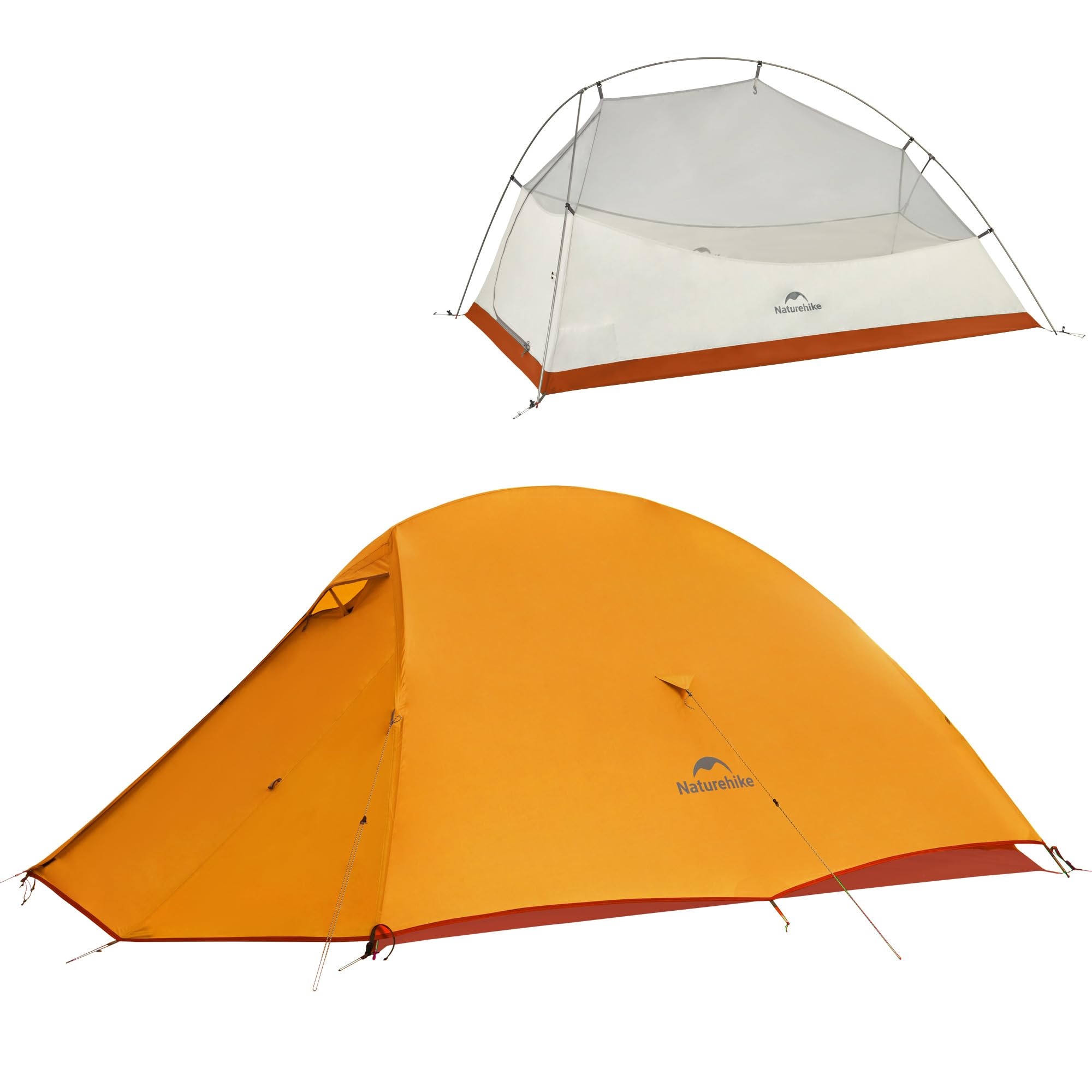
The Naturehike Cloud-Up 2. $101.15. $0.052 per gram.
Almost as cheap per gram as the budget tent, but an actual tent you'd actually carry. It's the point where the price-per-gram stops being a tax and starts being a tent. Not the lightest, not the cheapest — the one where the math says you're getting your money's worth on both axes at once.
The math on the two ends is stark. The $480 Nemo is almost five times the price of the $101 Cloud-Up, and what that buys you is a fraction of the grams — the last little shave, not the difference between a good night and a bad one. I'm not going to pretend the tents are identical. The Nemo is lighter, more refined, it does things the Cloud-Up doesn't. But five times the price for a marginal shave is exactly the "per-gram tax" the thread was arguing about, and exactly the thing I'd been defending for five years. The spreadsheet made it visible in one column, and I couldn't unsee it.
I stared at that spreadsheet for a while, and I want to be honest about what it did to me. I've spent five years on r/Ultralight arguing that premium tents earn their price. And the data — the boring, actual, dollars-per-gram data — said I'd been paying for a story, not a tent. The $480 Nemo isn't five times the tent that the $101 Cloud-Up is. It's five times the price for a fraction of the grams, and I'd convinced myself that fraction was worth it because everyone around me had convinced themselves too.
So I bought the Cloud-Up 2. $101.15. Added it to the cart.
To be fair to the other end of the curve: the Cloud-Up 2 is a $101 tent, not a $480 one. It's heavier, the materials aren't as refined, and in serious wind it's at its ceiling. The point of the cost-per-gram exercise wasn't "the cheap tent is secretly perfect" — it was that the $480 tent's advantage was a marginal shave, not a fundamentally better night. If you want the real comparison, I built a whole $500 kit around this same tent. And then I did the part that actually matters — I took it out and tested it, because a spreadsheet is just a spreadsheet until the weather has a say.
The honest weather
Before I took it out, it pulled the actual forecast for the weekend, and this is the part I respect almost as much as the spreadsheet. It gave me the real numbers — 15 mile-per-hour base winds with gusts, a rain band rolling through Saturday night — and I added the part the forecast leaves out: monsoon cells can double that, and it didn't round the wind up to make the test sound more impressive — didn't hide the rain either. A tool that's honest about the spreadsheet and honest about the weather is a tool whose field test actually means something. If the Cloud-Up 2 held up, I wanted it to be in those exact conditions, not a version somebody cleaned up to prove a point.
The field test
Colorado Trail section, a weekend with 26-mile-per-hour gusts and monsoon rain rolling through on the forecast. The kind of weather that makes you find out real quick whether a tent was a deal or a mistake.
It held. The Cloud-Up 2 took the wind and the rain and didn't flinch. I've paid almost five times as much for tents that were only marginally better, and here was a $101 tent doing the job without drama. The data held: the $101 tent took the same gust line a $480 Hornet would have. That's not a knock on the Hornet — it's stiffer and quieter, and 26 mph is the Cloud-Up's ceiling, not its comfort zone. It's just the data, repeated in the field: the numbers had said the sweet spot was $101, and the trail agreed.
I posted the whole spreadsheet to r/Ultralight. 2,847 upvotes. 412 comments. The top reply said it better than I could: "so I've been paying $345 for the last 1.5kg this whole time."
Five years. Five tents. And it took one conversation and a spreadsheet to end the argument I'd been having with myself. I sent the feedback to the CampMate team on the way back, because cost-per-gram isn't everything — but it turned out to be the exact thing I'd been missing the whole time I was busy defending the expensive stuff.
This is a real conversation with CampMate. Gear picks, budgets, and outcomes are all real. See the full conversation →