 Camp
Camp
Backpacking Gear Under $500: A Kit That Beats My $576
Backpacking gear under $500 — a real kit built to a budget: where to spend, where to save, and the $94 lesson.

Affiliate Disclosure: This post may contain affiliate links. As an Amazon Associate, CampMate earns from qualifying purchases — at no extra cost to you.
My current backpacking kit: 8.7 pounds base weight, and it cost me $576 to get there. I'm not unhappy with it. It works. But I got to thinking — what if I'd had a hard ceiling of $500? Not "what's the cheapest thing that technically works," but "how good does $500 actually get you?"
Those are two completely different questions, and most gear threads never notice the difference. The first question — "cheapest thing that works" — gets you a kit of 50°F kid-sized sacks and foam pads you can survive a night in, and a comment section full of people patting themselves on the back for being frugal. Surviving isn't the point. The point is: within $500, where do you spend and where do you save to get the best kit, not the cheapest one?
So I opened CampMate and made the challenge explicit. $500, hard cap. Tent, sleeping bag, pad, stove. Build me the best kit that fits — not the cheapest one that survives.
It stopped too early
Its first pass came back at $406.18 and called it done. "The $94 you have left won't buy a real upgrade," it said. "This is the answer."
And that's where I pushed back, because that's exactly the wrong instinct, and I'd seen it a hundred times in gear threads.
It had filed the first workable kit and stopped. But I didn't ask for the first workable kit. I asked what $500 buys. Leaving $94 on the table is only smart if that $94 genuinely does nothing — and that's a claim it made without checking. It assumed. I'd spent years on r/Ultralight watching people do the exact same thing: hit a number that "works" and stop optimizing, then call it discipline.
"You're not answering 'cheapest kit that survives,'" I told it. "You're answering 'how good does $500 get.'"
And here's the part that surprised me — it conceded. "You're right. I filed it at the first workable kit and stopped." Then it went back and actually tried.
Save on the tent. Spend on sleep.
The re-run was better, and the whole thing came down to one principle: priority. Where does money actually buy you quality of life, and where does it not?
The tent: save. The Naturehike Cloud Up 2P at $101.15 is the same tent I ran cost-per-gram on a few weeks ago — it's the value point. Spending $370 more on a tent buys you marginal grams and nothing else you'll feel at 3 AM. Skip it. This is where most people waste their budget, and where I used to waste mine.
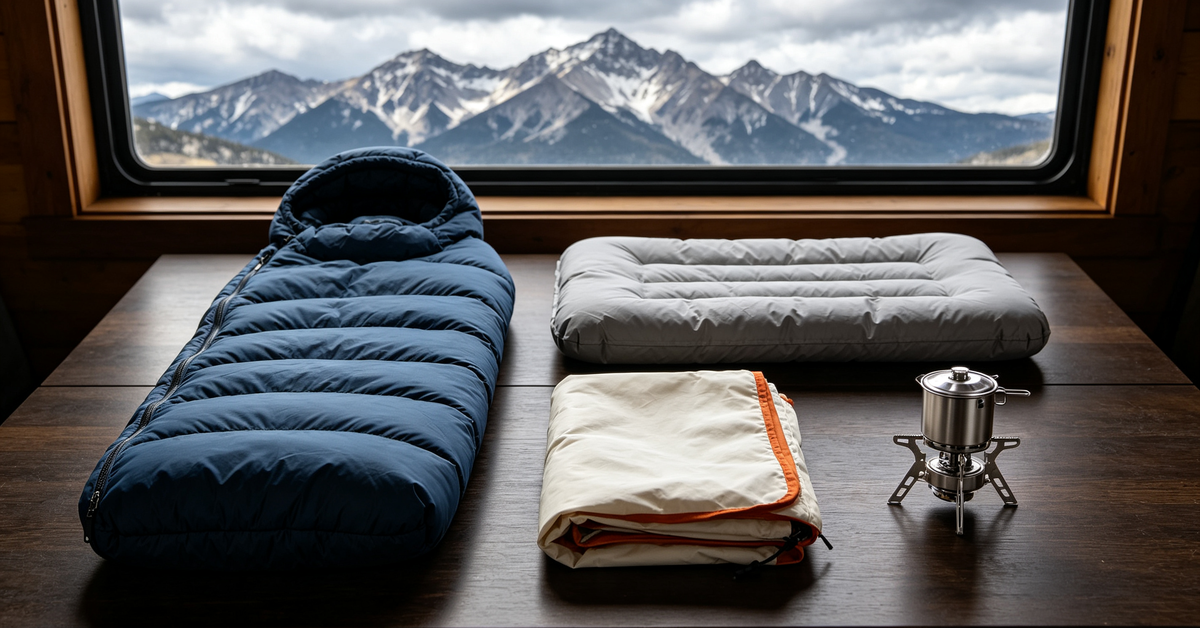
Sleep: spend. This ended up being 71% of the final budget, and that's not an accident, that's the whole answer. The Kelty Cosmic 20 down bag at $189.95, and a Sea to Summit Ultralight Insulated pad at $139.30 with an R-value of 3.5. Sleep is where the trip happens. A bad night ruins the whole thing; a good night covers a lot of compromises everywhere else. You feel a good sleeping bag every single night. You never once feel the extra $370 you saved on the tent.
The stove: the CAMPINGMOON XD-2F, $32.22. It boils water, and its built-in pressure regulator holds a steady flame in the wind — the $14 no-name the first pass had suggested would've sputtered in a 40 mph gust. That's the extra eighteen dollars, and it's the exact critique I'd thrown back at the AI.
Final total: $462.62, estimated 8.1 pounds. Thirty-seven bucks under $500 — but this time the leftover was earned, not filed away early.
The gear
| Gear | Category | Price |
|---|---|---|
| Kelty Cosmic 20 down sleeping bag | Sleep (spend) | $189.95 |
| Sea to Summit Ultralight Insulated pad (R-3.5) | Sleep (spend) | $139.30 |
| Naturehike Cloud Up 2P tent | Shelter (save) | $101.15 |
| CAMPINGMOON XD-2F stove | Cook (save) | $32.22 |
| Total | $462.62 |
That first run had also exposed the traps hiding at the bottom of the search, and they're worth naming. The cheapest tier of the catalog is full of 50°F kid-sized bags, foam pads with no insulation to speak of, and a 3.7-pound tent masquerading as a bargain. A budget optimizer that just sorts by price would've handed me that stuff and called it a kit. The whole point of the re-run — the thing I had to push it toward — was avoiding that. Backpacking gear under $500 isn't about the cheapest thing that technically exists. It's about the best thing the ceiling can reach. Cheap isn't the goal. The ceiling is.
The sleep search was its own frontier, and worth showing. Run a $500 budget across the sleeping bag category and you hit a Western Mountaineering VersaLite at $793 — a real bag, and more than the entire budget on its own, which tells you what the ceiling looks like when money isn't the constraint. On the other end, the bottom of the barrel — kids' sacks and warm-weather bags down around $28, fine for a warm summer night and a false economy the moment the temperature drops. The Kelty Cosmic 20 at $189.95 sits in the middle, and that's not a coincidence — it's the point where a 20°F down bag stops charging you for the label and starts just being warm. The budget didn't force me down to the $28 sack. It bought me the $189.95 one, because I'd already decided where to save: the tent, not the bag.
Where this kit compromises
Being honest about the $500 kit: the tent is the compromise. The Cloud-Up 2 is a value tent, not a premium one — it's heavier and less refined than the $480 options, and in serious wind it's at its ceiling. You feel the savings on the tent and you never feel it at 3 AM. The sleep gear (the bag and pad) got the real money, because that's where a bad night ruins a trip. If you only remember one thing from this build: spend where you sleep, save where you don't.
What to upgrade first
When the budget grows, the first upgrade isn't the tent. It's the pad — the R-3.5 was enough for that 36°F night, but a warmer, thicker pad is where more money would actually show up. Then the bag (a down bag with a real comfort rating), then the stove. The tent stays last: it's the item where $370 more buys you marginal grams and nothing you'll feel at 3 AM.
FAQ
Is $500 really enough for a full backpacking kit? Yes — tent, bag, pad, and stove for $462.62, and it field-tested through a 40mph night. What do you cut if the budget is $400? The pad first (a lighter R-value pad), then the bag. Is ultralight worth the premium? Only if you're carrying it for real distance; for most trips, the value point wins.
Related read: the cost-per-gram math that started the whole tent question.
The field test
A spreadsheet is a hypothesis. So I took it out to the Monarch Crest section — 36°F night, winds gusting to 40 mph, the kind of conditions that expose whether you saved money in the right places or just cheaped out.
I slept warm. The R-3.5 pad and the 20°F bag did their jobs, no layering gymnastics, no 3 AM wakeup. The regulator stove held a steady flame in the wind. The tent took the gusts without drama. Nothing about that night felt like a compromise kit, because it wasn't one — it was a $462 kit where every dollar sat exactly where it matters.
The math worked out to $113 cheaper than my old kit, roughly the same weight, and better sleep. Same weight. Better sleep. $113 back. That's not a trade-off. That's just a better decision, hiding in plain sight the whole time.
Here's the lesson, and it's not really about gear. Budget isn't the excuse people think it is. The difference between a $406 kit and a $462 kit isn't money — it's whether you ask "what's the best this buys" instead of "what's the cheapest that works." I had to remind the AI of that. Most people never even ask it of themselves.
The whole thing would've been easy to get wrong, and I've watched people get it wrong for years. A budget isn't a ceiling you scrape against. It's a prioritization exercise, and most gear threads skip the exercise and call the result frugal. The $500 didn't limit the kit. It revealed where the money actually belongs.
I sent the feedback to the team after the trip. Priority's the whole lesson: spend where it sleeps, trim where it doesn't.
This is a real conversation with CampMate. Gear picks, budgets, and outcomes are all real. See the full conversation →