 Camp
Camp
Yosemite Backpacking: 3-Day Gear Under $400
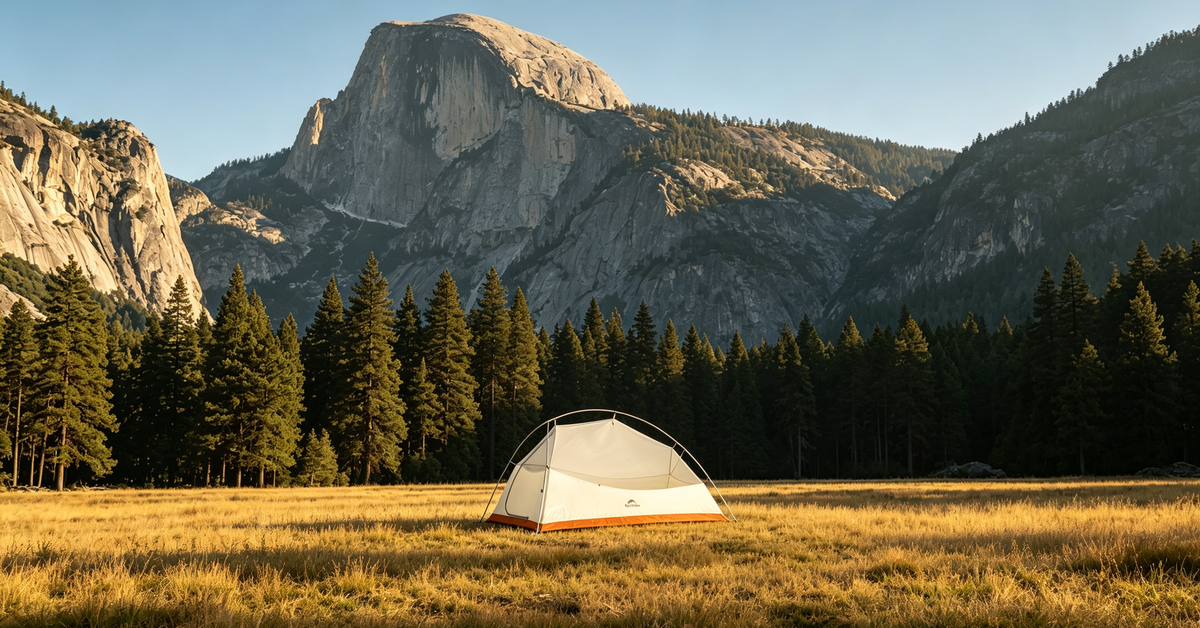
Yosemite backpacking gear — a compact 3-day kit under $400, built in 20 minutes: light enough to carry, cheap enough to enjoy.

Affiliate Disclosure: This post may contain affiliate links. As an Amazon Associate, CampMate earns from qualifying purchases — at no extra cost to you.
I get two free weekends a month. That's it. Not three, not four. Two. So when one of them lines up with a friend who's also free, and we lock in three days of Yosemite backpacking, I do not have an evening to burn reading gear reviews. I need a decision, and I need it fast, and I need it to not be wrong.
That's how this started. Two people. Three days. Backpacking. We needed a two-person tent and two sleeping pads. Light enough to carry, cheap enough to not hurt. Those two requirements fight each other. Everyone knows it. The lightest pad runs close to $260. The cheap pad weighs fourteen ounces. I didn't want to waste my weekend optimizing that. I wanted the number that makes both work.
So I opened CampMate and said exactly what I meant: three days in Yosemite, mid-September, two people — keep it light, but not crazy expensive. Don't make me regret it.
The tent was easy
The tent took no time. It lined up the options and the answer came down to a three-way trade-off, in numbers: the ultralight end, the budget end, and a point in the middle. The lightest ran close to $480 — the kind of tent that wins on a spec sheet and loses on my credit card. The budget end was a $26 dome, which is a tent in the same way a grocery-bag raincoat is a jacket. And in the middle, the balance point — once I'd vetoed the trekking-pole tent it floated first — landed on the Naturehike Cloud-Up 2, $101.15, 1,950 grams, freestanding.
It had actually pitched me a trekking-pole tent first — lighter on paper, because you use your poles as the frame. And I pushed back, because I don't always carry poles, and I wanted something that stands up by itself. It switched without arguing. Twenty minutes in and the tent was settled.
Here's the honest version of choosing a 2-person backpacking tent: the real options were the ultralight end at around $480, a budget dome at $26, and something in the middle — and the right pick depends on whether you're carrying it. We carried it, so the Cloud-Up 2 won on weight and price. For car camping, the $26 dome would have been fine. A tool that lays out that trade-off beats a site that declares one tent "the best."
It also gave me a weather caveat up front: my dates were far enough out that it couldn't forecast them yet, and it said so, told me to re-check three days before. No fake certainty. Just the numbers and an honest "I can't see the weather that far." I made the call in twenty minutes.
That's the bar, for me. If a tool can settle the tent in twenty minutes, it's already paid for itself. But the pads were where it got interesting, and where it earned my attention.
The trade-off
I'm a cold sleeper. Always have been. If the ground is cold, I wake up cold at 3 AM, and then the whole next day is ruined — I'm tired, I'm slow, and I resent the trip I paid for. My friend is the opposite. She runs hot, and she wants to carry as little as possible. So when it asked, I said it straight: I sleep cold, my friend runs hot, give me the warmer pad and her the light one. Two pads, two different jobs.
The AI ran with it, and caught a thing I'd have missed. Its first "light pad" suggestion for my friend — a Nemo Tensor Trail — was somehow $260, pricier than my warm pad. The whole "warm pad for me, cheap pad for her" split was backwards on price. It flagged that out loud, and went and found a Therm-a-Rest Z Lite SOL for $60 instead: closed-cell foam, fourteen ounces, indestructible, and it doesn't demand a big commitment from someone who runs hot.
Then there was my pad. And here's the part I didn't think was worth the words until I was staring at the numbers: I am a side sleeper, and I have woken up with a dead hip on too many thin pads to count. When it pulled its first recommendation — a Nemo Tensor, R-value 5.4, and it was warmer, lighter, and cheaper than the pad I'd been circling — I almost said yes, because on paper it beat the other option on every single number. Who argues with warmer, lighter, and cheaper?
I did, it turns out. My hips had voted years ago, and they don't read spec sheets. I told it the thing I'd been holding back: I sleep on my side, I need real cushion under my hips and back, and R-4.8 is more than enough for a September night in Yosemite.
It stopped, and it agreed with me. The line it came back with: side-sleeper hips beat an R-number you'll never need in September. That's not a tool defending its first answer. That's a tool listening when I told it something about my body it couldn't have guessed.
Three points on a line. That's all it took. I looked at the three options and knew myself. Cold sleeper, side sleeper. The pad with the cushion. Done.
Two pads, two people
The fix was more elegant than I expected. I got the warm, thick pad — a Big Agnes Rapide SL, R-4.8, wide, 4.25 inches of cushion — because I'm the one who freezes and sleeps on her side. My friend got the light one — a Therm-a-Rest Z Lite SOL, R-2, fourteen ounces, because she's the one who wants to carry less. I'd said upfront we'd need two different pads; the part I didn't expect was the AI making that split actually make sense on price — flagging that the obvious "light" pad cost more than my warm one, and finding a cheap light one instead of letting my friend overpay.
This is what I mean when I say I want a tool that's practical. It didn't upsell me. It didn't drown me in options. It read my situation — two people, different bodies, different needs — and handed me a decision I could actually make.
The gear
| Gear | Who | Weight | Price |
|---|---|---|---|
| Naturehike Cloud-Up 2 tent | Both | 1,950 g | $101.15 |
| Big Agnes Rapide SL pad (R-4.8, wide) | Me (cold + side sleeper) | 726 g | $209.95 |
| Therm-a-Rest Z Lite SOL pad (R-2) | Her (warm + light) | 397 g | $59.95 |
| Total | 3.07 kg | $371.05 |
The total: $371.05, 3.07 kilograms across three pieces. The tent came in around a hundred bucks. The pads — one warm and cushy, one light — brought the whole thing to where I actually wanted it. I wasn't trying to hit some arbitrary number; I was trying to not come home with back pain.
The trip
We went. It worked.
I slept warm. No 3 AM cold, no dead hip, no ruined next day, no resentment. She carried her fourteen-ounce pad and didn't complain once about the weight. The Cloud-Up 2 held up through three days of Yosemite — including one night of light rain it shrugged off — which is more than I can say for the last tent I owned.
Twenty minutes to decide the gear. That's what I paid for, and that's what I got. We spent more time arguing about who carries which food bag than we did about any of the equipment. Which is exactly how it should be — the gear should be settled so the trip can be the point.
When I got back, CampMate asked if I wanted to send feedback to the team. I said yes. It took two minutes. Two weekends a month — I am not wasting either one on gear research, and I'm not coming home from either one with a sore back.
The part that surprised me, looking back, is how little I actually had to decide. One trade-off — lightest, balanced, budget — settled the shelter. Two facts about myself — I sleep cold, and I sleep on my side — settled the sleep. I didn't read a single review or open a comparison table on some blog. I told it two things about myself, and the rest was arithmetic. For a person with two free weekends a month, that's the whole product. It's not the gear. It's the twenty minutes.
The lesson isn't that Yosemite backpacking gear is easy. It's that the trade-off is the point. Light, warm, cheap — you can't have all three, and pretending otherwise is how you overspend. And the moment you hand the tool one fact about your own body, it stops solving for a generic backpacker and starts solving for you. The tool that makes you look at that trade-off and decide in twenty minutes is worth every cent.
This is a real conversation with CampMate. Gear picks, budgets, and outcomes are all real. See the full conversation →